

Part I — Capital Framework
Executive summary
The capital requirement to take an open-source, full-spectrum cannabis extract standard (WPCE-01) from organizational formation through FDA approval for a single primary indication, paired with three open delivery platforms (orally disintegrating tablet, oral thin film, enteric capsule) and made available to qualified manufacturers under non-exclusive licensing, is approximately $85 million to $155 million over six years. The range reflects scope choices, trial size, and the degree to which the three delivery platforms are developed in parallel versus sequentially.
This total is substantially below the industry-average cost of commercial FDA-pathway drug development (roughly $1 billion per approved drug, fully loaded) and is in the same order of magnitude as the cumulative funding the Usona Institute has deployed for its open-source psilocybin program (~$100M+ over the past decade). The lower cost relative to commercial development reflects: a single primary indication initial scope; nonprofit overhead structures; open-science publication that does not require proprietary protection programs; published prior art that reduces IP-prosecution overhead; and a multi-manufacturer post-approval ecosystem that is governed centrally rather than built as a single-firm commercial operation.
The program is conventionally fundable: staged, milestone-gated, with each tranche producing public artifacts that expand the commons and reduce later capital risk. The phasing below is designed so that Phase 1 ($4–7.5M) delivers irreversible public infrastructure, a published WPCE-01 reference standard with analytical methods, a foundation IP estate held in public-benefit trust, a complete Investigator’s Brochure v1.0, and a credible pre-IND package, even if subsequent phases never get funded.
Operating assumptions
These shape the budget. They are documented here so funders, partners, and reviewers can interrogate the assumption set rather than the totals.
• Single primary indication initial focus. Chronic low back pain, modeled on the Vertanical VER-01 trial program. The substitution-for-opioids therapeutic frame is well-established (Bachhuber 2014, Powell-Pacula-Jacobson 2018, Bradford & Bradford 2016) and now confirmed at Phase 3 RCT level (Karst et al. Nature Medicine 2025; Meissner et al. Pain and Therapy 2025). The chronic low back pain population is large, the endpoint is robust, and the regulatory pathway is established.
• Three delivery platforms developed in parallel. ODT, oral thin film, and enteric capsule. Parallel development saves time but adds incremental cost (roughly 60–80 percent of three sequential programs rather than 200–300 percent). The platforms differ in PK profile, patient population fit, and manufacturing complexity; carrying all three avoids picking a winner prematurely and supports a multi-manufacturer post-approval ecosystem.
• GMP-aligned manufacturing from Phase 1 forward. No bench-only chemistry. Cannabis-derived botanical products require chromatographic batch consistency and a controlled supply chain from cultivation forward; cutting CMC corners is what kills botanical programs at Phase 3.
• Nonprofit sponsoring entity, 501(c)(3), with a public-benefit governance charter. Board composition includes patients, clinicians, scientists, regulatory experts, manufacturing partners, and public-interest legal counsel. Transparency requirements written into the charter, not as policy.
• Defensive publication as the primary IP strategy. WPCE-01 specifications, analytical methods, and formulation enabling approaches published early to function as prior art. Patents filed only on delivery interfaces where prior-art coverage would not adequately prevent commercial enclosure, held in trust and licensed non-exclusively.
• Open publication of trial protocols, statistical analysis plans, and de-identified data. ClinicalTrials.gov plus institutional repository; no contract-research-organization data exclusivity.
• Post-approval multi-manufacturer ecosystem. Drug Master File held by the sponsoring nonprofit and referenced by qualified manufacturers via written authorization (21 CFR 314.420). No single-manufacturer dependency.
• Realistic CMO and clinical-trial pricing for the U.S. and European pharmaceutical-services market as of mid-2026. Numbers reflect actual quotes received in adjacent peptide-formulation and clinical-trial programs, scaled for botanical complexity.
Phase 1 — Foundation and Standard (Months 1–12) — $4.0M to $7.5M
The phase that produces the durable public infrastructure regardless of what happens later. Each line item below produces a publishable artifact.
• Nonprofit formation, 501(c)(3) determination, governance charter, public-benefit entity registration, code of conduct, IP-trust structure: $250K–500K
• Founding scientific and clinical advisory boards, initial executive staff (Executive Director, Chief Scientific Officer, Director of CMC, Director of Regulatory Affairs), shared services: pro-rated $750K–1.5M for Phase 1
• Legal counsel (regulatory, IP, governance): $250K–500K
• WPCE-01 specification development: botanical raw material qualification, chemovar selection and characterization, extraction process development, analytical fingerprinting, reference standard creation, initial stability protocols: $500K–1M
• Initial CMC development across the three delivery platforms (formulation chemistry, excipient selection, prototype batch production): $1.5M–2.5M
• Manufacturing partner identification, qualification, quality-agreement negotiation: $500K–1M
• Investigator’s Brochure v1.0 drafting under ICH-GCP standards: $250K–500K
Phase 1 deliverables: the WPCE-01 monograph, the analytical method dossier, the IB v1.0, the IP-trust documents, the charter, are all publishable artifacts that establish prior art and reduce enclosure risk even if subsequent phases never fund.
Phase 2 — IND-Enabling (Months 13–30) — $9M to $18M
• Pre-IND meeting preparation and FDA engagement: $250K–500K
• Full formulation development across three dosage forms: $2M–4M
• Stability program (24-month real-time plus accelerated for each dosage form): $750K–1.5M
• Targeted nonclinical work where literature support is insufficient: $500K–1.5M
• Phase 1 first-in-human PK and safety study (single dosage form lead, with bridging cohorts; n ~60–80): $3M–5M
• GMP-grade manufacturing scale-up for clinical supply: $2M–4M
• Drug Master File establishment with FDA: $500K–1M
• IND submission: $250K–500K
• Continuing operations and overhead: $1.5M–2.5M annualized
Phase 3 — Proof of Concept (Months 31–48) — $17M to $29M
• Phase 2 clinical trial in chronic low back pain (dose-finding and proof of concept, n ~250–400 patients, 12–24 week treatment plus open-label extension): $15M–25M
• Clinical supply manufacturing across dosage forms: $1M–2M
• Statistical and data-management infrastructure (publishing protocol, SAP, and de-identified data to open repository): $500K–1M
• Regulatory affairs: $500K–1M
• Continuing operations: $2M–3M annualized
Phase 4 — Pivotal Program and NDA (Months 49–72) — $55M to $100M
• Phase 3 randomized controlled trial (multicenter, placebo-controlled, ~600–820 patients matching the Vertanical design): $40M–75M
• Long-term safety extension study (52-week open-label): $10M–15M
• GMP-grade manufacturing for Phase 3 and registration batches: $3M–5M
• NDA preparation, submission, and FDA review interactions: $2M–5M
• Continuing operations: $3M–5M annualized
Phase 5 — Approval, Launch, and Multi-Manufacturer Ecosystem (Months 73+) — $7M to $15M per year, ongoing
• NDA review and approval support: $5M–10M (one-time)
• Multi-manufacturer qualification and reference-authorization ecosystem: $2M–5M per year
• Post-market surveillance, pharmacovigilance reporting: $2M–5M per year
• Ongoing program operations and governance: $3M–5M per year
Cumulative totals — all-cash baseline
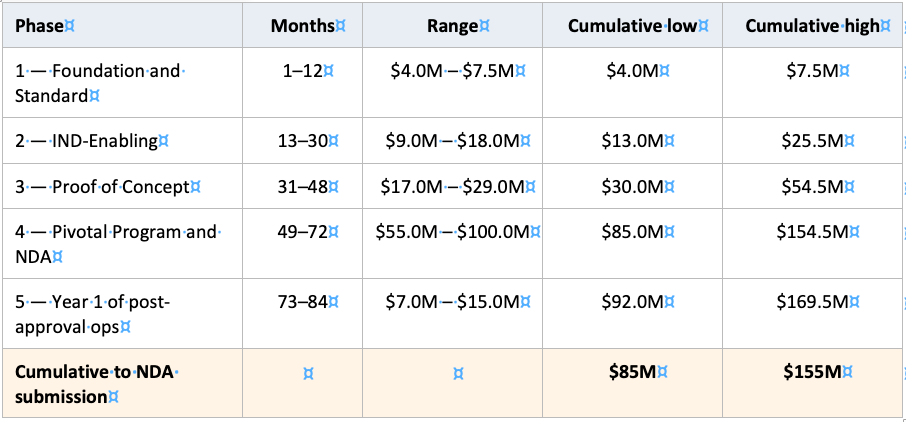
Subsequent indications (osteoarthritis, painful diabetic peripheral neuropathy, anxiety, sleep, others identified by the substitution literature) can be added under the same regulatory umbrella at marginal cost, roughly $25M–$50M per additional Phase 3 indication, given that the CMC, manufacturing, analytical, and DMF infrastructure are already in place.
Comparative context
Commercial pharmaceutical-grade cannabis development (Vertanical comparable)
Vertanical’s own public materials describe “more than eight years of dedicated research and development” and “tens of millions of Euros annually” in R&D investment. The Vertanical Phase 3 program (VER-01 in chronic low back pain, n=820, with an opioid-comparison arm in n=384) is in the same scale as Phase 4 of this proposal. Public estimates put Vertanical’s cumulative VER-01 investment in the €80–150M range, i.e., directly comparable to the public-domain program total here. The cost is roughly equivalent; the access architecture is the variable.
Full industry-average commercial drug development
Tufts Center for the Study of Drug Development estimates of fully loaded commercial drug development costs (~$1B per approved drug, including failed candidates). The public-domain program achieves NDA approval at roughly 10–15 percent of the industry-loaded average, because it carries a single program (not a portfolio of failed candidates), uses literature-supported nonclinical work, and operates under nonprofit overhead.
Usona Institute psilocybin program (nonprofit precedent)
Usona has invested an estimated $100M+ cumulatively over the past decade in the public-domain development of psilocybin for major depressive disorder. The program produced a published Phase 2 trial, an open Investigator’s Brochure that has become a de facto field reference standard, and is currently running a Phase 3 program for MDD. The Usona model is the existence proof that nonprofit-sponsored FDA-pathway development at this scale is achievable.
Cost-efficiency notes
Three sources of cost advantage that reduce the public-domain program total relative to a single-firm commercial path:
• Open publication reduces IP-prosecution overhead. Commercial firms typically spend 5–10 percent of total program cost on patent prosecution, prior-art surveillance, and infringement defense. The public-domain program spends a fraction of that on defensive publication and a narrow patent estate on delivery interfaces.
• Literature-supported nonclinical work. Commercial firms run extensive proprietary tox programs because their NDA package cannot reference public data. The public-domain program references published literature on cannabinoid pharmacology and toxicology where the body of evidence is sufficient, conducting targeted nonclinical work only where gaps exist.
• No commercial brand-building. Commercial drug development typically allocates 15–25 percent of program cost to brand strategy, market-access positioning, KOL development, and pre-launch marketing. The public-domain program does none of this, the deliverable is regulatory legitimacy, not a brand.
Part II — In-Kind Contribution Analysis
Realistic estimate of how much volunteer, pro bono, and preferred-partner contribution can reduce the cash requirement.
In-kind contributions can realistically reduce the cash requirement of the program by 15 to 22 percent across the full six-year arc to NDA submission, roughly $13 million to $34 million of the $85–155 million baseline budget. This is meaningful but bounded. The program at this scale cannot be built primarily on volunteer labor; GMP manufacturing, clinical-trial site execution, stability programs, and regulatory submissions are real cost centers that require cash. The realistic cash requirement, after maximizing in-kind, is approximately $70 million to $130 million over six years.
That is the honest answer. The expansionary fantasy that says “the cannabis community will volunteer this” is a fundraising failure mode. The conservative reality that says “no one will give us anything” undersells what nonprofit-sponsored health-technology programs have actually achieved. The categories below identify what is gettable, what it is worth, who has done it before, and what the limits are.
Category 1 — Legal counsel (IP, regulatory, governance)
Realistic in-kind value: $2.0 to $4.5 million across the program lifecycle.
This is the single highest-leverage in-kind category. Major law firms with pharmaceutical biotech IP and FDA regulatory practice groups operate substantial pro bono programs and routinely take on public-interest health-technology cases. The Usona Institute’s regulatory and IP strategy has been built on substantial pro bono support from Cooley LLP and other tier-1 firms.
What is realistically obtainable
• Public-benefit entity formation, 501(c)(3) determination, governance charter drafting, IP-trust structure design — $200,000 to $400,000 of equivalent billable work in Phase 1.
• IP strategy and prior-art surveillance program, defensive publication strategy, narrow patent estate on delivery interfaces — $400,000 to $800,000 over Phases 1 and 2.
• FDA regulatory counsel (pre-IND through NDA): meeting preparation, submission review, sponsor-investigator agreements, DMF reference-authorization framework — $500,000 to $1,200,000 across Phases 2–4.
• Ongoing compliance, board governance, manufacturing contract review, post-approval licensing — $300,000 to $700,000 across Phases 3–5.
Specific firm targets to approach
Cooley LLP (significant cannabis IP and biotech experience, Usona Institute precedent). Foley Hoag (cannabis regulatory work). Arnold & Porter (FDA regulatory, deep pro bono history). WilmerHale (biotech IP). Latham & Watkins. Goodwin Procter. Hogan Lovells (botanical drug regulatory experience). Reach the partners through bar-association pro bono coordinators and through direct introduction from foundation funders, who routinely facilitate these connections.
What is not realistically obtainable pro bono
• The volume work of NDA submission preparation. Pro bono partners lead but won’t carry the full submission lift.
• IP litigation if the patent estate is challenged. Pro bono ends at offense; defense requires paid counsel.
Category 2 — Scientific and clinical advisory boards
Realistic in-kind value: $1.5 to $3.0 million across the program lifecycle.
This is the category where the cannabis-medicine field has the largest pool of plausible volunteers. Senior cannabinoid researchers, pain-medicine clinicians, regulatory-experienced physicians, and former FDA reviewers will serve on advisory boards for $0 cash if the program’s scientific seriousness is established. Board service worth $50,000 to $150,000 per senior member per year in consulting-fee equivalent is normal at this scale.
What is realistically obtainable
• A 6–10-member Scientific Advisory Board contributing 4–8 hours per month each — $400,000 to $800,000 per year of equivalent consulting.
• A 4–6-member Clinical Advisory Board of pain and integrative-medicine clinicians — $200,000 to $500,000 per year equivalent.
• Independent Data and Safety Monitoring Board members for Phases 2 and 3 at honorarium-only rates — saving $200,000 to $400,000 across the clinical program.
Specific advisor targets
For cannabinoid science: Ethan Russo, Mahmoud ElSohly (University of Mississippi NIDA cannabis program), Mark Wallace (UCSD), Igor Grant (UCSD). For political-economy and patient-advocacy: Sue Sisley, Donald Abrams (UCSF, retired). For regulatory experience: former FDA CDER reviewers in retirement. For pain-medicine clinical advisory: Mark Wallace, Lynn Webster, Mary Lynch (Dalhousie). The cannabinoid-medicine clinical research community is small and reachable, and senior figures have a documented willingness to serve on advisory boards for mission-aligned programs.
Category 3 — Academic medical center partnerships for clinical trials
Realistic in-kind value: $6 to $18 million across Phases 2 through 4.
This is the category with the largest potential dollar savings and the most variable execution risk. Academic medical centers will conduct nonprofit-sponsored trials at substantially below commercial-CRO pricing — typically 30 to 50 percent below standard rates — when the program is mission-aligned and the institution sees the participation as part of its research mission. This is how Usona has structured its psilocybin Phase 2 and Phase 3 work.
What is realistically obtainable
• “Preferred academic partner” pricing on Phase 1 PK studies — 30–40 percent off commercial CRO pricing, saving approximately $1.0 to $2.0 million.
• Academic-network Phase 2 proof-of-concept trial (3–5 academic sites), saving $3 to $6 million off the commercial baseline.
• Academic-network Phase 3 pivotal trial (8–15 sites), saving $5 to $15 million off commercial baseline.
• IRB fee reductions, free institutional regulatory consultation, shared statistical/data-management infrastructure — saving $500,000 to $1,500,000 across the clinical program.
Specific institutional targets
UCSF (Center for Medicinal Cannabis Research at UCSD), UCSD, UC Berkeley public-health partnerships. Johns Hopkins (psychedelic and pain research infrastructure). University of Pittsburgh (significant pain research). Dartmouth-Hitchcock. University of Vermont (cannabinoid research program). The University of Miami’s Halland Chen (already in the BioUnbound network) is an existing relationship that could anchor the Phase 1 PK study. Hopkins, UCSF, and UCSD are the strongest U.S. candidates.
Critical caveats
Academic partnerships save 30–50 percent off CRO rates but they do not save 100 percent. A 600-patient Phase 3 trial through academic partners still costs $25 to $50 million. Do not let funder conversations treat academic partnerships as “free trials.” And academic medical centers have variable timelines and bureaucracies. The cost of academic partnerships is often delivered as schedule risk rather than as cash.
Category 4 — Board, executive, and audit services
Realistic in-kind value: $0.4 to $1.0 million across the program lifecycle.
A public-benefit nonprofit board operates without paid director compensation. This saves $200,000 to $500,000 across the lifecycle relative to a commercial entity. The CEO and CSO roles will be salaried, but the founding executive team can be expected to take below-market salaries for the first 24–36 months (50–70 percent of commercial equivalent), saving approximately $200,000 to $400,000 over that window. Pro bono accounting and audit services from a tier-1 firm with a public-benefit practice group are obtainable. Saving: $50,000 to $150,000 across the lifecycle.
Category 5 — Communications, publication, and infrastructure
Realistic in-kind value: $0.3 to $0.8 million across the program lifecycle.
Open-access publication fee waivers can be negotiated with publishers (Springer, BMC, Frontiers, PLOS) for nonprofit public-domain work. Pro bono communications and PR support from values-aligned firms is obtainable in the initial-launch phase, saving $100,000 to $300,000. Pro bono technology infrastructure — website, document repository, registry of qualified manufacturers — through volunteer or low-bono technical contribution is realistic for early phases. ClinicalTrials.gov registration, DOI registration through CrossRef or Datacite, institutional repository access through partner universities — all available at low or no cost.
Category 6 — Donated clinical comparators and reference materials
Realistic in-kind value: $0.5 to $2.5 million across Phases 3 and 4.
If the Phase 3 trial includes an opioid comparison arm (as the Vertanical ELEVATE trial did), the comparator opioids must be obtained. Some manufacturers will provide investigational supply at no cost or below cost for academic and public-benefit research, particularly for off-patent generic opioids. Comparator drug supply for a 600-patient trial at investigational pricing could save $300,000 to $1,000,000. Reference standards and analytical materials from public-domain sources (NIST, USP) save additional cost.
What cannot realistically be obtained in-kind
Honesty about the floor matters. The following cannot be expected as substantial in-kind contributions:
• GMP-grade contract manufacturing. GMP capacity is constrained and expensive; CDMOs do not give it away.
• Stability program execution. Stability requires controlled storage at multiple conditions for 24+ months. Real lab and instrument time, paid.
• Phase 1, 2, and 3 patient compensation, study coordinator time, and clinical-site operational costs. Even at academic-partnership pricing, these are paid.
• Regulatory submission preparation work at scale. The NDA submission alone is hundreds of staff-hours of regulatory writing.
• Long-term clinical staff salaries. A six-year program with a 4–8-person core staff requires $1.5–2.5 million per year in payroll. This is the largest unavoidable cost.
Revised cumulative totals — cash requirement after realistic in-kind
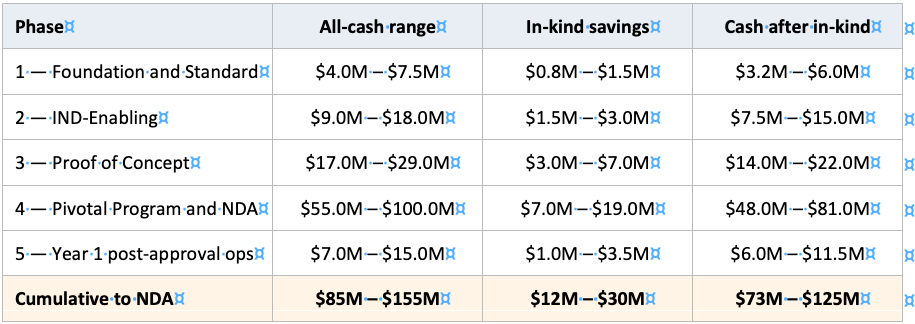
Maximizing in-kind contribution reduces the cash requirement by roughly 15 to 20 percent — meaningful, defensible to a funder, but not transformative of the program’s overall scale.
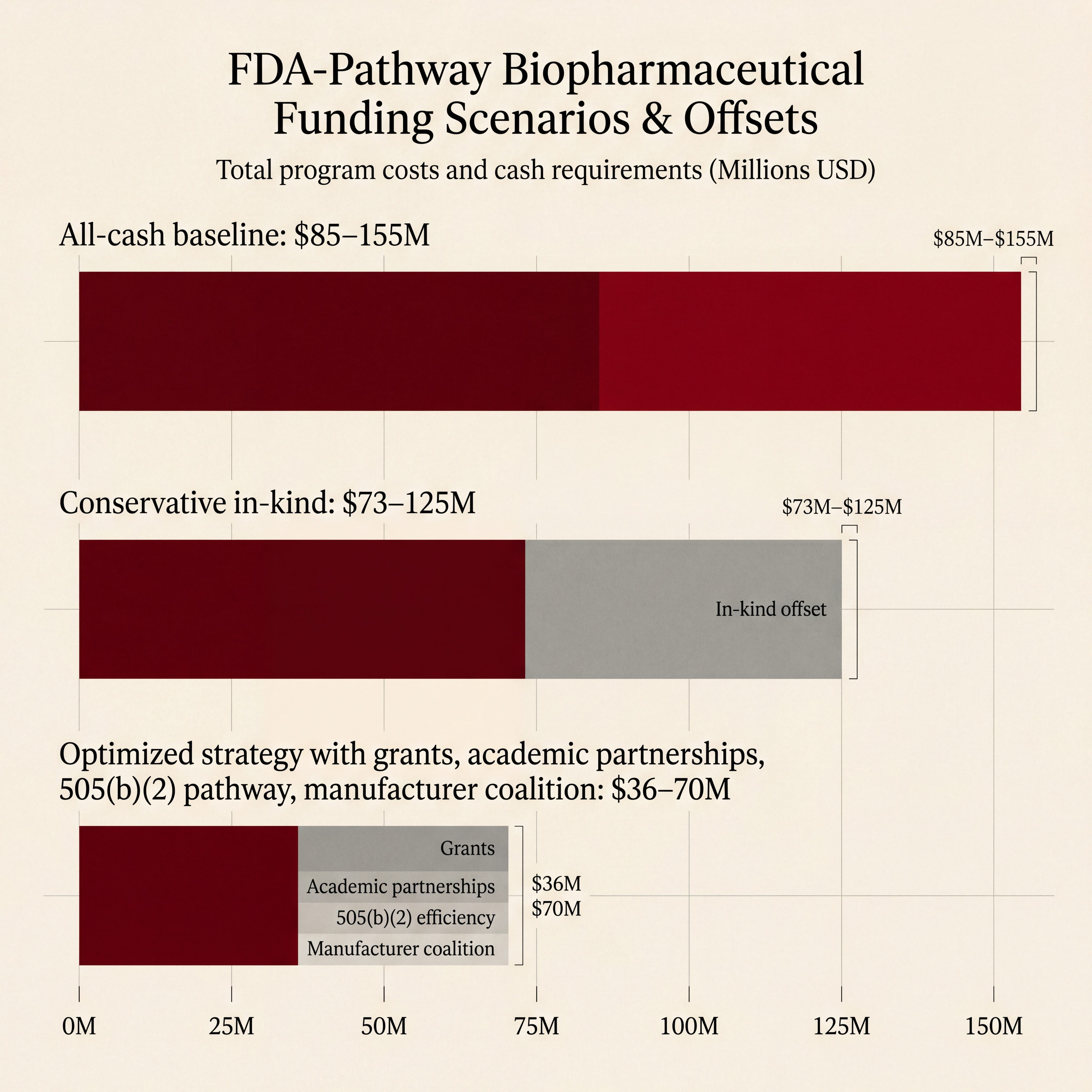
Part III — Optimized Strategy
Pulling every reasonable lever the public-domain space actually has access to.
The categories above are pure in-kind contribution. They do not capture the larger set of cost-reduction levers available to a well-structured public-benefit health-technology program. When all reasonable levers are activated together, the cash requirement to NDA submission falls substantially below the in-kind-only adjusted totals, into a range where philanthropic and federal-grant funding can realistically cover the program without requiring the cannabis-policy or wellness-philanthropy community to underwrite the entire arc alone.
Five additional levers materially change the strategy.
Lever 1 — Government research grants (NIH, NIDA, NCCIH, VA, DoD)
Realistic value: $15 to $30 million across the program lifecycle.
The federal research-grant environment for cannabinoid medicine is the strongest it has been in fifty years. NIH’s HEAL Initiative on pain and addiction includes a substantial cannabinoid research portfolio. NCCIH (National Center for Complementary and Integrative Health) explicitly funds botanical drug development. NIDA has historically funded cannabinoid pharmacology and substitution research. The Department of Veterans Affairs has an active interest in cannabinoid medicine for veteran chronic-pain and PTSD populations. The DoD Congressionally Directed Medical Research Programs include a Pain Management Research Program that has funded cannabinoid investigations.
A nonprofit-sponsored open-science FDA-pathway program with strong academic-partnership infrastructure is a natural fit. A Phase 2 chronic-low-back-pain trial could plausibly be funded as an NIH HEAL R01 ($3–5M direct costs) or a VA Merit Review award ($2–4M). A Phase 3 program component could be supported by NIDA cooperative-agreement mechanisms (U01, U54) at $5–15M.
The grant-writing competitive process is a real cost — figure 100–200 hours of senior staff time per major submission, with realistic success rates of 15–25 percent on first submission. The program should budget for two or three high-quality submissions per year across the lifecycle.
Lever 2 — VA / DoD partnership for chronic-pain trial execution
Realistic value: $5 to $12 million in Phase 2 and Phase 3.
The Veterans Health Administration operates the largest integrated health system in the United States, with documented chronic-pain and opioid-substitution research programs. A VA-co-sponsored trial leverages existing clinical infrastructure (sites, patients, electronic medical records, clinical staff) at far below commercial-CRO pricing. The VA has been a partner on several previous cannabinoid-medicine investigations and supported MDMA-PTSD research through the MAPS partnership. A VA cooperative-research agreement on a Phase 2 chronic-low-back-pain trial could plausibly reduce the trial’s net cost by 60–70 percent.
The DoD CDMRP funding pathway has supported cannabinoid investigations and could underwrite specific Phase 2 components targeting military and veteran chronic-pain populations.
The trade-off: VA and DoD partnerships impose specific protocol requirements, reporting obligations, and population-focus constraints. The chronic-low-back-pain program fits these constraints well; broader population trials require commercial-equivalent infrastructure.
Lever 3 — 505(b)(2) pathway with reference to published Phase 3 evidence
Realistic value: $25 to $40 million reduction in Phase 4 cost — and a 24-month timeline acceleration.
This is the largest single lever in the optimized strategy and the one that fundamentally changes the program’s economics.
The FDA’s 505(b)(2) New Drug Application pathway permits reliance on safety and efficacy data already in the public domain, including published clinical-trial data, to support approval of a related product. The Vertanical VER-01 Phase 3 trial in chronic low back pain (Karst et al., Nature Medicine 2025) is now public. The Phase 3 ELEVATE trial against opioids (Meissner et al., Pain and Therapy 2025) is now public. The full clinical-trial registries and clinical study reports for both will become accessible through standard regulatory disclosure timelines.
If the WPCE-01 program produces a full-spectrum extract characterized at a chromatographic profile within a defensible similarity envelope of the DKJ127 chemovar — or a defensibly different but comparably-characterized profile with bridging PK data — the 505(b)(2) pathway permits reference to the existing published efficacy evidence rather than de novo replication. The program would still need to produce its own Phase 1 PK bridge to demonstrate equivalent exposure-response, its own Phase 2 proof-of-concept dose-finding study, and a smaller confirmatory Phase 3 (potentially n=200–300 rather than n=600–820), but would not need to replicate the full Vertanical-scale pivotal program.
This is the architecturally most important lever. It is also the lever that the Usona Institute has explicitly designed for in its public materials: open-science publication creates prior art and reference data that downstream public-domain programs can lean on. The cannabis-medicine field is, after the Vertanical publications, at the threshold of this becoming operational. The same dynamic that gave Vertanical its commercial advantage now becomes the public-domain program’s accelerator.
Phase 4 cost under 505(b)(2) strategy: approximately $25 to $50 million rather than $55 to $100 million.
Lever 4 — Academic fiscal-sponsor model
Realistic value: $3 to $7 million in operational and infrastructure savings.
Rather than building a standalone 501(c)(3) with its own back-office, the program can be housed initially as an institutional initiative at a partnering academic medical center — UCSF, Johns Hopkins, UCSD, or comparable. The institutional sponsor provides governance infrastructure, grant-administration capacity, indirect-cost recovery through federal grants, payroll and benefits administration, and IRB and research-compliance services at well below the cost of building them from scratch.
The trade-off: the program operates under institutional oversight rather than independent governance, which complicates the public-benefit charter commitments. The Usona Institute model is the standalone-nonprofit precedent; an academic-housed initial structure could transition to standalone status at Phase 3 once operational scale justifies it.
Lever 5 — Manufacturer co-investment in Phase 4
Realistic value: $10 to $25 million in Phase 4 cost-sharing.
Post-Phase 2, with credible proof-of-concept data and a published Investigator’s Brochure that has acquired field-reference status, the program can credibly invite qualified manufacturers to co-invest in the Phase 3 pivotal program in exchange for early reference authorization to the Drug Master File and inclusion in the post-approval qualified-manufacturer ecosystem.
This is not equity in the program; it is paid participation in a regulatory commons that the manufacturer will be a beneficiary of. A coalition of 5–10 qualified manufacturers each contributing $1.5–3 million at Phase 3 entry can carry $15–25 million of the Phase 4 cost without compromising the public-domain governance commitment. The pricing of post-approval reference authorization is non-exclusive and accessible to manufacturers who did not participate in Phase 3 funding, preserving the open ecosystem; the Phase 3 co-investors simply get earlier authorization and seat-at-the-table participation in ecosystem governance.
This model is structurally similar to how the Critical Path Institute, the Pre-Competitive Consortium for Translational Innovation, and the Innovative Medicines Initiative (Europe) have funded shared infrastructure across multiple manufacturer participants. It is not naive; it is how pharmaceutical-industry consortia routinely structure cost-sharing on pre-competitive infrastructure.
Optimized cumulative totals
When all five additional levers are pulled, government grants, VA/DoD partnership, 505(b)(2) pathway, academic fiscal sponsor, manufacturer co-investment, alongside the pure in-kind contributions analyzed above, the cash requirement to NDA submission falls substantially.
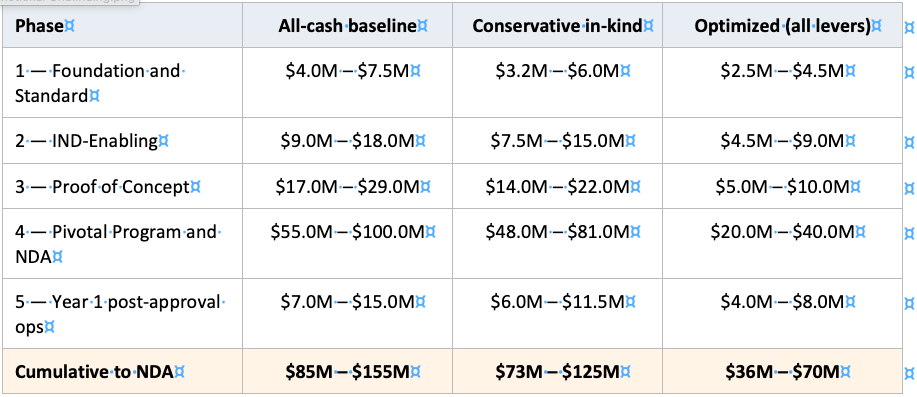
The optimized strategy reduces the philanthropy-required cash to approximately $36 to $70 million across six years to NDA submission. This is roughly 40 to 55 percent of the all-cash baseline.
That is a fundable program at the scale of a single major foundation commitment (MacKenzie Scott has written $50M+ public-health checks routinely; Bloomberg Philanthropies, the Helmsley Charitable Trust, the Robert Wood Johnson Foundation operate at this scale; the cannabis-philanthropy and drug-policy network can collectively muster this scale across a coalition). It is no longer a $100M+ ask that requires a transformational lead donor; it is a $40–70M ask that fits inside the operational range of established public-health philanthropy.
Sequencing the strategy
The optimized scenario depends on sequencing; most of the cost reductions are conditional on producing strong intermediate artifacts that unlock the next set of levers.
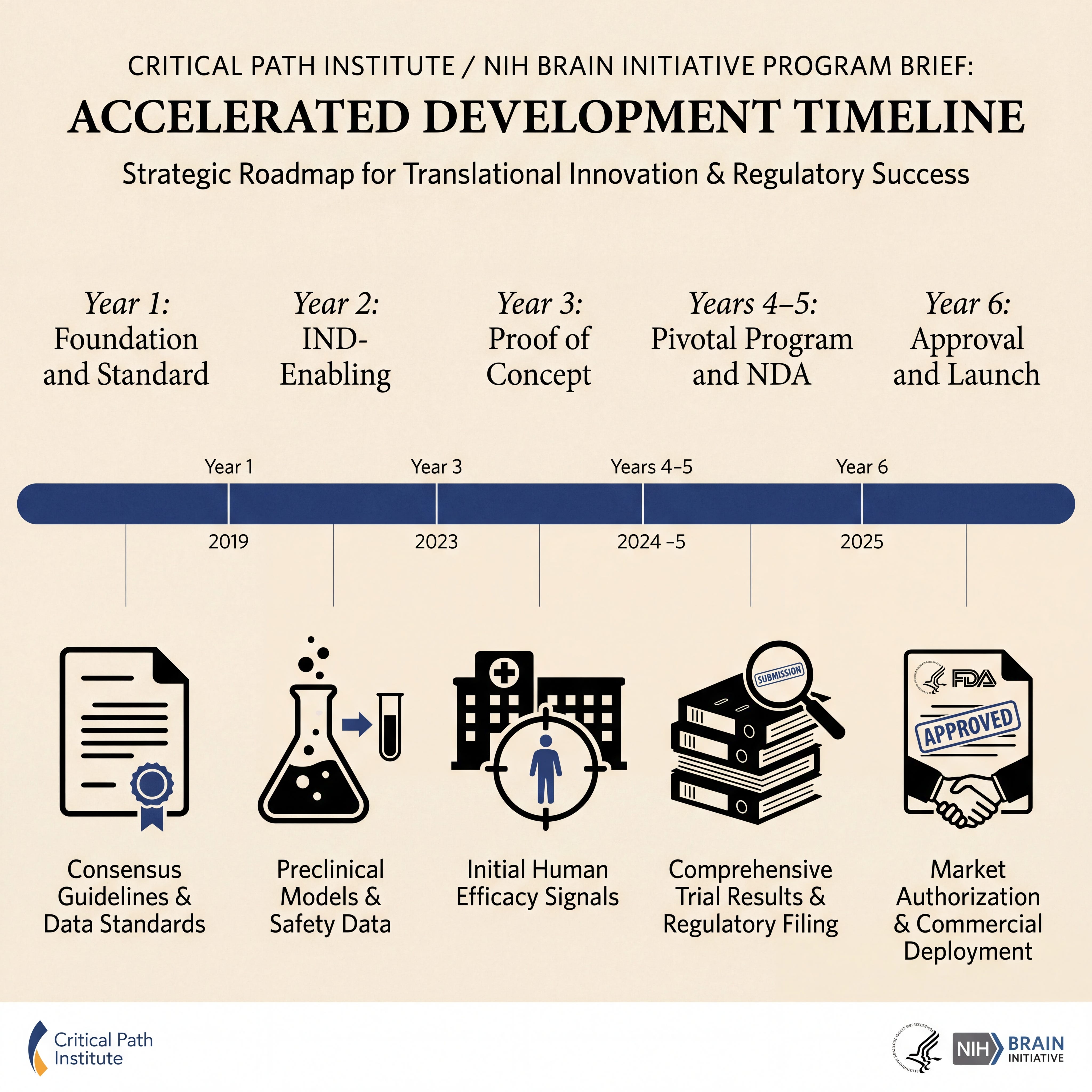
Year 1 (Phase 1): Build the founding coalition and produce the WPCE-01 monograph, the Investigator’s Brochure v1.0, the analytical methods dossier, the IP-trust documents, and the published governance charter. Establish the academic fiscal-sponsor relationship. Convene the Scientific and Clinical Advisory Boards. First NIH/NCCIH/HEAL submissions filed in Q3–Q4. Initial pro bono legal partnerships engaged.
Year 2 (Phase 2): Pre-IND meeting with FDA, IND submission, Phase 1 PK study (academic site, partner pricing). First NIH grants beginning to fund. VA cooperative-agreement discussions opening. Pro bono legal infrastructure fully operational. Manufacturer-coalition cultivation begun.
Year 3 (Phase 3): Phase 2 proof-of-concept trial under NIH HEAL or VA cooperative agreement. Vertanical clinical-study reports become accessible through standard regulatory-disclosure timelines, opening the 505(b)(2) reference pathway analytically. Manufacturer coalition coalesces around credible proof-of-concept data.
Years 4–5 (Phase 4): 505(b)(2) Phase 3 confirmatory trial (n=200–300) under academic cooperative-group infrastructure with manufacturer co-investment. NDA preparation.
Year 6: NDA submission, FDA review, approval.
The sequencing has a structural property worth naming: every phase produces the public artifact that justifies the next phase’s funding. If Phase 1 fails to deliver the WPCE-01 monograph and the IB v1.0, the academic and grant infrastructure for Phase 2 does not engage. If Phase 2 fails to deliver the IND and the Phase 1 PK readout, the VA cooperative agreement does not close. If Phase 3 fails to deliver credible proof-of-concept, the manufacturer coalition does not materialize. This is a disciplined milestone-gated structure that funders find easier to underwrite than open-ended commitments.
What the actual ask becomes
A realistic, fully-optimized version of the ask, for the founding coalition to present to philanthropic funders, foundation program officers, and the cannabis-medicine community organizing around the proposal:
Phase 1 seed: $3 to $5 million from a founding coalition of two or three lead philanthropists or a single foundation grant. Produces the WPCE-01 monograph, the IB v1.0, the IP-trust infrastructure, the academic-partnership letters of intent, and the first NIH submissions.
Phase 2 ramp: $5 to $10 million to fund the IND-enabling work and the first-in-human study, with $3–5 million expected from NIH/HEAL/NCCIH grants and the balance from foundation philanthropy.
Phase 3 proof of concept: $5 to $10 million in cash to the program plus $10–15M in government-grant pass-through (NIH, VA, DoD cooperative agreements) covering the bulk of the Phase 2 clinical trial.
Phase 4 pivotal program: $20 to $40 million in cash to the program, with $10–25 million expected from manufacturer coalition co-investment and government grants covering the balance of the trial.
Phase 5 launch and ongoing ops: $4 to $8 million per year, transitioning to self-sustaining via non-exclusive licensing fees from qualified manufacturers.
Total philanthropy ask: $36 to $70 million over six years.
This is the version of the strategy that is most reasonable to present. It is conservative in its discount assumptions, defensible to a foundation program officer, and structurally honest about what the federal-grant and academic-partnership and manufacturer-coalition infrastructures can actually carry. It is also the version that gives the cannabis community a realistic path: not “we need to raise $150 million,” which is daunting and probably impossible, but “we need to assemble a $40–70 million coalition over six years, with most of it coming from established public-health philanthropy and federal-research-grant infrastructure that already exists.”
The window remains the next eighteen months.
Companion document to the published Public Domain Whole-Plant Cannabis Medicines Program proposal. Numbers are calibrated to mid-2026 U.S. and European pharmaceutical-services market rates, reflect realistic CMO and CRO pricing for adjacent peptide and botanical programs, and are intentionally banded rather than point-estimated. Designed as the basis for a detailed bottom-up budget developed with named manufacturing partners, named clinical-trial sites, and a defined sponsoring nonprofit governance structure, the next step after a credible founding coalition is assembled.